
Thirty Years of Saying Nothing
After thirty years of advising under other institutions' logos, we are publishing the mechanisms. Issue 01 introduces the Delivery Gap — the distance between funded strategy and on-the-water delivery — and the four-question test that surfaces it early.
For thirty years, our work has appeared under other people’s logos.
That is not modesty; it is the job. When you advise a multilateral bank on structuring a loan, a government on building its monitoring system, or a foundation on where capital is truly additional, the work belongs to the institution carrying it. Our name is omitted from the cover, and that discretion is the price of admission.
Nothing in this publication changes that. We will not name a client. Not once, not ever.
However, after three decades inside the rooms where ocean money is committed and programmes are designed, we are breaking a different habit.
We are going to publish the mechanisms.
Something Has Shifted, and It Is Not a Cycle
Four structural shifts are occurring simultaneously across the ocean economy:
- The rules changed. Shipping faces a net-zero framework combining mandatory fuel standards with carbon pricing for vessels over 5,000 gross tonnage, accounting for 85% of sector emissions. Seafood traceability is now a requirement for market access. The EU requires digital catch documentation, and the US monitors over 1,100 species at entry.
- The biology changed. In 2022, aquaculture surpassed wild capture in aquatic animal food production for the first time, reaching 130.9 million tonnes valued at $313 billion. This is a permanent shift in how humanity harvests the sea.
- The money arrived, but fails to land. SDG 14 remains the least-funded UN goal, with an annual gap of $150 billion against under $10 billion invested over a recent five-year period. Ocean philanthropy provides roughly $1.2 billion annually, concentrated among twenty core funders. Too much of what is raised is absorbed by administrative friction before reaching the water.
- Targets outran management. Nearly 10% of the ocean is designated as protected, yet under 3% is effectively managed. We are measuring paper coverage while missing ecosystem function.
Together, these shifts represent a structural phase change. The operating conditions of the sector have permanently reset.
The Constraint Has Moved
The binding constraint in the blue economy used to be money. It is not any more.
Capital is arriving from multilateral banks, bilateral funds, foundations, and private markets. Yet strategies are still written as though money were the bottleneck.
What is actually missing is execution.
We watch this unfold repeatedly. The strategy is approved, funding is committed, and the press release goes out. By month four, the plan meets reality:
- Misaligned incentives between immediate fishing community needs and twenty-year conservation targets.
- Diffused accountability where every partner owns a component, but nobody owns the interface between them.
- Horizon mismatches between three-year political cycles and thirty-year biological recovery curves.
None of this appears on a donor scorecard, yet the programme quietly strands. That distance between paper strategy and operational reality is the Delivery Gap.
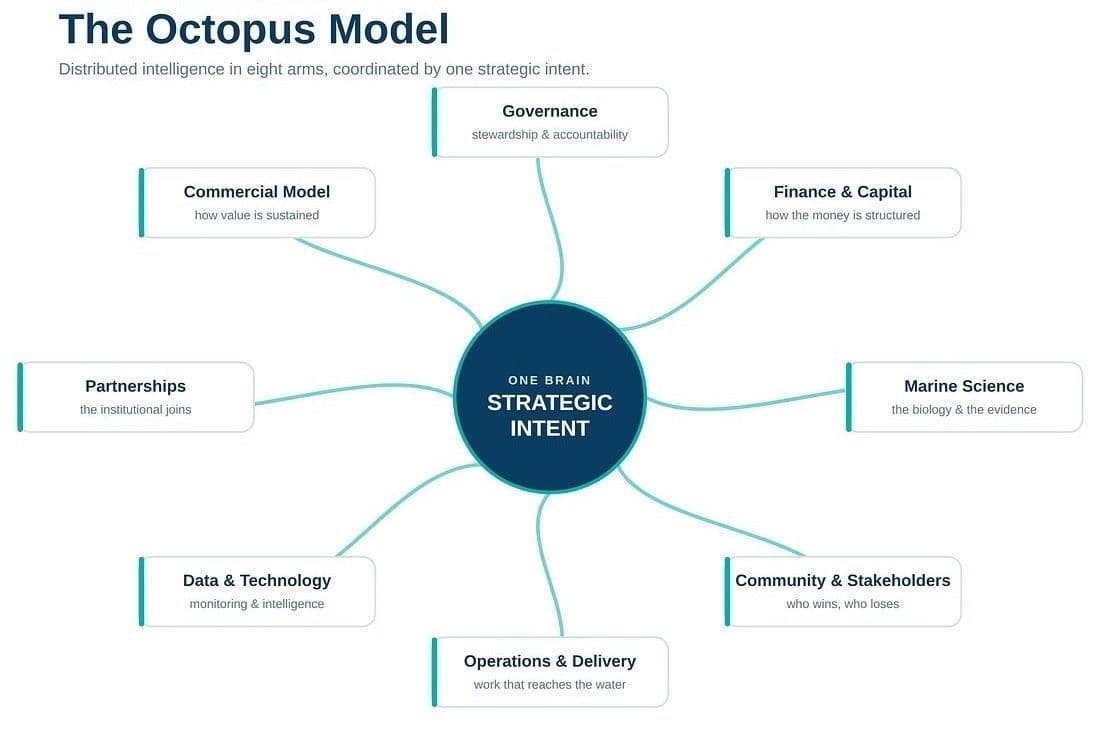
The Octopus Model
When faced with complexity, the standard institutional response is to divide it. Put a finance structurer in one room, a fisheries lead in another, and a community team on a separate donor schedule.
That model worked when the system was stable and the pieces were separable. It fails today. When rules, biology, capital, and governance move simultaneously, dividing the problem produces coordination cost rather than outcomes.
Almost none of the failures we see are technical. Nobody gets the biology wrong. They are integration failures.
An octopus does not manage complexity with a larger brain. Two-thirds of its neurons are in its arms. Each arm senses, decides, and acts on what is directly in front of it, while the central head maintains intent and keeps the animal coherent. Having no skeleton, it takes the shape the situation demands rather than the shape it prefers.
That is not a poetic metaphor. It is how ocean advisory work actually functions. Institutions attempting to run complex marine systems strictly from headquarters will keep producing paper parks and stranded capital.
THE MECHANISM: The Delivery Gap Test
Before your next ocean initiative disburses a pound, test it against these four questions. Each requires a direct answer; most programmes cannot supply one.
- Who loses if this succeeds? Name them. Every ocean intervention creates trade-offs: a fleet, a licence holder, a middleman, or a ministry budget line. Unnamed losers surface at month nine as unexplained delays.
- Who owns the join? Name the single person or entity accountable for the interfaces between partners, ministries, and workstreams. If the answer is “the steering committee”, nobody owns the join.
- What is the horizon mismatch? State the political cycle length against the ecological recovery timeline in years. State explicitly what carries the work across the gap. If nothing does, the programme has an expiry date it does not yet know about.
- Who is still here in year five? Name the local institution, counterpart, or community maintaining the work after consultants depart. If the honest answer is “us”, you have built a dependency, not a programme.
Scoring: Any question you cannot answer in a single sentence is a live delivery risk. Two or more, and the money will disburse on schedule while the outcome fails to arrive.
What This Publication Will Be
We are not offering commentary. This publication is built on four editorial commitments:
- One practical mechanism per issue. A test, structure, or decision rule you can apply directly to your portfolio.
- Uncomfortable numbers. Transparent data, including metrics that challenge sector assumptions or our own past designs.
- Verifiable candour. Every issue details a past failure and what we learned. Work that never failed was never ambitious enough.
- Strict confidentiality. Client identity is permanently protected. Where we cite our own published reports, we cite them as public record.
THE OPENING
- The dying assumption: That securing capital commitments automatically leads to on-the-water delivery.
- The replacing model: Stress-testing institutional joins, local incentives, and delivery mechanics before capital deployment.
- Where the opportunity sits: Structuring programmes around operational realities rather than theoretical milestones.