
Seventy-Two Interviews and Almost Nothing a Bank Could Lend To
We were asked to map who finances what in the blue economy across four coastal economies. We could not find enough activity a lender was legally permitted to touch. The constraint was never the instruments. It is the rung everyone skips: registered entities, tenure written down, small producers aggregated into one counterparty a bank can assess.
The terms of reference asked for forty-eight interviews across four coastal economies in two oceans. A bilateral facility wanted to know who was financing what in the blue economy, and where its own capital could be genuinely additional rather than another line in an already crowded room.
We ran seventy-two, which should have been the first clue that something was wrong, though it took most of the assignment to work out what. Ministries, commercial banks, multilaterals, foundations, insurers, the people running the money and the people who cannot get near it. By the end we had been given the same explanation in six different vocabularies, and it was the wrong explanation.
The diagnosis everyone arrives with
Ask anyone working in blue finance what the sector is short of and the answer comes back shaped like a product list: blue bonds, parametric insurance, blended facilities, convertible notes, debt conversions, risk-sharing structures. There is a conference for each of them, usually in a city with good hotels, and the papers presented at those conferences are serious and frequently excellent.
The diagnosis follows from the product list. If the money is not moving, the sector has not yet built the vehicle that will move it, so the work is to keep engineering until one of them fits. We arrived carrying that assumption and spent four months watching it fail to explain anything we found.
What was actually on the ground
Across the four economies we mapped, we could not locate enough activity that a lender or an investor was legally permitted to touch. The shortage was never in coastal enterprise itself. There is a great deal of it, much of it profitable, and a good proportion of it has been running for a generation. The obstruction sits earlier in the chain, in the parts nobody presents at conferences: informal operation, no audited accounts, uncertain tenure over the ground or the water, uneven local governance, and no digital footprint that a credit committee could inspect. Those constraints bite hardest on exactly the groups the capital is meant to reach, which is small-scale fishers, cooperatives, and aquaculture producers with real revenue and no paperwork to prove it.
Our closing finding to the client read: instrument availability is not the primary constraint; the constraint is matching instruments to bankable, aggregated pipelines that meet regulatory, safeguard, and risk requirements. Three things from the fieldwork changed how we structure advisory work after that.
The first was that the portfolio told the truth well before the strategy caught up. When we analysed the facility’s own deployment record instead of its strategy documents, the majority of what it had spent had gone to technical assistance, with grants comprising a smaller share. The chequebook had reached our conclusion some time earlier. Nobody had said so aloud, and the annual planning still read as though the binding problem were a shortage of capital.
The second was a bond that cannot be traced. In one of the economies, a commercial bank had issued a blue bond now widely cited as evidence that the model works. We went looking for where the proceeds landed and found almost no public information showing which activities received the capital, or whether any of it reached a small-scale fisher or a hectare of habitat. The people citing the bond as proof are, on this point, in the same position we were. They cannot verify it either.
The third was an accreditation cliff that nobody designed and everybody lives with. Many conservation organisations accredited to the large climate funds are permitted to hold grants and nothing else. Consider what that does to the life of a project. The institution best placed to prepare a coastal initiative, the one that has spent twenty years earning trust in a particular bay, is legally barred from carrying debt, guarantees, or blended capital at the moment the project becomes ready for them. The sequence from preparation to investment breaks at precisely the point where it should accelerate, and it breaks for administrative reasons that have nothing to do with the quality of the work.
Where we went wrong first
We ran fifty percent more fieldwork than the terms of reference required, and at the time we called it thoroughness, which was a generous reading. Our evaluation framework had not narrowed the question tightly enough before we got on the plane, so the interviews ended up doing structural work that desk research should have finished first. Running well beyond your own scope is occasionally generosity. More often it means you have not yet worked out what you are looking for, and you are hoping the next conversation will tell you.
The Readiness Ladder
Capital cannot skip rungs. Before designing or deploying another instrument, place the target initiative honestly on this ladder and then accept where it lands.
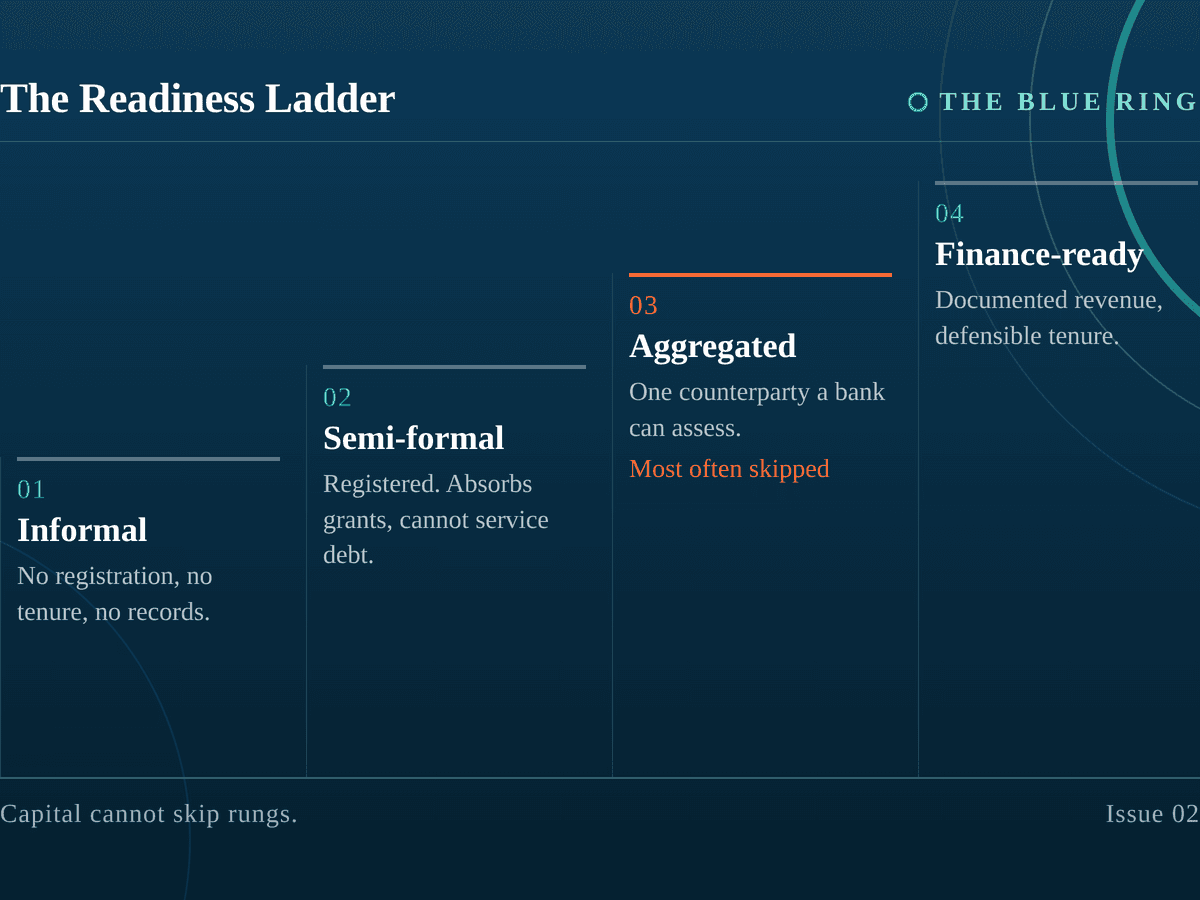
Rung one, informal. No registration, no legal tenure, no financial records. What is needed here is formalisation, and treating it as a finance problem will cost everyone a year.
Rung two, semi-formal. A registered entity with basic governance and no aggregation. It can absorb technical assistance or grants. It cannot service debt, and it should not be asked to.
Rung three, aggregated. A cooperative, producer group, or special-purpose vehicle that consolidates supply, reduces transaction costs, and presents a single counterparty to capital. This is the rung the sector skips, and it is the one that makes everything above it possible.
Rung four, finance-ready. Documented revenue, defensible tenure, secure offtake, and safeguards that a credit committee will accept.
Three questions before capital moves. First, which rung is the initiative actually on, judged on its documents rather than its proposal? Most failures in blue finance happen when an instrument designed for rung four is pressed onto a rung two entity that had no realistic way of refusing it. Second, can your delivery partner legally hold the next instrument in the sequence, rather than the current one? Check the accreditation and not the mission statement, because a lead partner restricted to grants gives you a cliff where you thought you had a pipeline. Third, can you trace where the last deployment landed? If not, hold the next tranche. An instrument whose destination cannot be verified is not evidence of anything.
The sector has spent a decade getting very good at the part of the problem it enjoys. Financial engineering is interesting work, it attracts talented people, and it produces something to announce at the end of a quarter. The rung that is missing is dull by comparison. Registering entities, writing down who owns what, consolidating two hundred unbankable units into a single counterparty a bank can assess: none of that wins an award, and until somebody builds it the instruments will keep arriving at a shore with nowhere to land.
That is where we would put the next pound (or dollar).
See also: CEA's Our Shared Seas Ocean Funding Report (2025) for a decade-long view of where capital in blue finance has actually landed across four continents.